
Table of Contents
Introduction
What is PingFederate?
What is SSO and What is the Role of PingFederate?
What is Identity Federation?
How does PingFederate work?
Difference Between PingFederate IdP and PingFederate SP
How is PingFederate Related to SAML?
PingFederate and OAuth 2.0 / OIDC
Key components and concepts of PingFederate
What is a PingFederate Federation Hub?
Real-World PingFederate use cases
How Can Functional Consultants Use PingFederate?
What Does a Functional Consultant Collect Before SSO Implementation?
List of Common PingFederate SSO problems and troubleshooting tips
PingFederate interview Q&A
FAQ Related to PingFederate
Final thoughts
Introduction
Now consider if you had to log in with a different username and password to each business application. Logging into several systems at once, and keeping track of each employee’s logon and password, can be tedious. It can also pose new problems for IT administrators, responsible for authentication, access control and security.
Here lies the significance of Single Sign-On (SSO) and Identity Federation. They allow users to use multiple applications at once, yet give organizations the convenience of centralizing their authentication and access controls.
One widely used solution for implementing these capabilities is PingFederate. But what exactly is PingFederate? How does it assist in the SSO and federated identities process? What is the difference between an IdP and SP? And then, what are the functions of SAML, OAuth 2.0, and OIDC in the authentication and authorization process?This introduction to PingFederate provides a solid introduction to the fundamental terms, authentication flows, authentication concepts, and common use cases in simple terms, which will be helpful for the subsequent PingFederate training.
What is PingFederate?
PingFederate is an enterprise federation server for authentication, Single Sign-On (SSO) and identity federation. It aids organizations to create trusted relationships in between identity systems, applications and users.
PingFederate is a standards-based solution that can be deployed for various enterprise applications and identity environments such as SAML, OAuth 2.0, OIDC and WS-Federation.It can be used to centralize the management of authentication, instead of doing its own authentication for each application.
How Does PingFederate Work in an Enterprise?
Organizations can use PingFederate for:
- Enterprise SSO
- Identity federation
- Federated access for employees, partners, and other users
- SAML application integration
- OAuth 2.0 and OIDC implementation
- Integrating apps to current identity infrastructure
- Centralized authentication policies
- Modernizing authentication to legacy and cloud applications
Why is PingFederate Important in Enterprise IAM?
There are a lot of applications, several directories, and several users in different environments in large organizations.
If authentication is managed per application, it becomes more complex to manage. PingFederate can help to build trust between Identity Providers (IdP) and applications and help organizations to take advantage of the well-known identity standards. This makes authentication easier and provides a consistent user login experience.
What does SSO mean, and how does PingFederate fit into SSO?
Single Sign-On (SSO) enables a user to authenticate to multiple applications in one stroke and not sign in to each application.
PingFederate can help in this process by integrating the authentication systems of an organization with apps that users will access.
That is, what matters is that no application gets the user’s password. To the contrary, the application relies on an authentication result or token from an approved identity system.
Simple SSO Example
Imagine that one employee requires access to Microsoft 365, Salesforce and an internal HR application.
The employee might have to log in to each individual system, if there is no SSO.
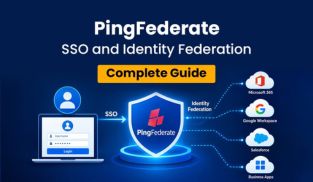
SSO allows the employee to log in using the organization’s identity system. Trusted applications can then use the federation response returned to them to gain access.
When viewed from the employee’s point of view: Single sign on for multiple applications.
What is Identity Federation?
Identity federation enables trust between different organizations, applications or security domains and exchange of identity information among them.
For instance, Company A can handle employee identity management, and Company B can offer an application that the employees have to log into. Company B can rely on the authentication that Company A has provided, without having to keep their employees’ authentication credentials separate.
Identity Federation is based on that trusted relationship.
SSO vs Identity Federation
Although related, Single Sign-On (SSO) and Identity Federation are not synonymous. SSO deals with the user’s seamless authentication experience with many applications while identity federation establishes trust and shares identity information between various identity domains.
| SSO | Identity Federation |
| Focuses on simplifying the user login experience | Focuses on establishing trust between different identity domains |
| Allows users to access multiple applications without repeatedly authenticating | Allows trusted systems to exchange authentication and identity information |
| Can operate within a single organization or identity environment | Often connects different organizations, identity providers, or security domains |
| Primarily addresses the user authentication experience | Primarily addresses trust and interoperability between identity systems |
SSO and Identity Federation are sometimes combined. SSO can offer users an easy-to-manage authentication process across trusted applications, whereas Identity Federation can create trust between the identity system and applications.
How Does PingFederate Work?
The process is described by the protocol and configuration; a simple SSO flow is as follows:
- The user sends a request for an application that needs authentication.
- The application determines the IdP it needs.
- The user is referred to the authentication system.
- The user enters in the authentication method that is configured.
- PingFederate generates or processes the required federation response (e.g., SAML assertion or token).
- The application checks the response and verifies it is from a trusted source.
- The user attributes are translated into the format the application can use.
- Access is granted, and a session is created in the application.
Difference Between PingFederate IdP and PingFederate SP
IDP
The Identity Provider (IdP) is an entity that authenticates the identity of the user and supplies identity data to the trusted applications. The data may be transferred in the form of assertion, token or any other form of authentication response.
One example of this is when an organization has an employee who needs to access an external SaaS application with SSO, PingFederate could serve as an IdP.
SP
A Service Provider (SP) is an application or service that depends on an IdP to get authenticated users and user information.
Basic SAML SSO Flow
Simplified SAML Flow is as follows:
User logins into the application that submits SAML assertion to an IdP. The IdP provides the authentication information to the user, which then leads to access to the application.
The Identity Provider verifies the user’s identity and issues a SAML assertion digitally signed. The application verifies and establishes a session for the user if the assertion is valid. The application must not ask for the user’s password.
OAuth 2.0 / OIDC and PingFederate
OAuth 2.0 and OIDC can be used in combination. They serve different purposes.
OAuth 2.0 is designed to be an authorization framework. OAuth 2.0 is an open protocol which helps the application to get access to protected resources.
OIDC is an extension to OAuth 2.0 for authentication. It can be used to validate the application’s identification of a user.
The easy way to recall:
OAuth 2.0 → “What can this application access?”
OIDC → “Who is the user?”
PingFederate can be used in OAuth 2.0 and OIDC use cases and therefore is applicable to traditional enterprise SSO as well as today’s application architectures.
Key Concepts and Components of PingFederate
Connections
Connections are the means by which PingFederate communicates with a federation partner or application.
A connection is a collection of configuration information needed to establish the relationship between the systems participating in the connection.
Authentication Adapters
Multiple authentication adapters can be linked to PingFederate and to one or more authentication mechanisms and identity sources.
They are used to identify the user to be authenticated prior to PingFederate proceeding with the federation process.
Attribute Mapping
While authentication is a fundamental piece of security, applications may require more information about the user, like an employee ID, department or role.
Attribute mapping relates information from the authentication source to the information that is expected by the target application.
Authentication Policies
Authentication policies provide the rules for handling authentication requests based on the conditions that are configured.
An organization might require a different type of authentication for the high-risk application as opposed to a low-risk application, for example.
Real-World PingFederate Use Cases
Following are the number of practical scenarios where PingFederate can be used:
Employee SSO: Employees log in to multiple SaaS and internal applications with their corporate identity.
Partner access: Businesses can provide trusted application access to suppliers, vendors and partners.
Customer authentication: Applications that are presented to customers can call back to centralized identity services.
Application modernization: Organizations can be able to link legacy applications to newer identity and cloud environments.
Modern applications and APIs: OAuth 2.0 and OIDC capabilities are available.
What is gathered by a Functional Consultant prior to implementing SSO?
In order to implement a Successful Single Sign-On (SSO) implementation, a Functional Consultant should compile the essential business, application, identity and security requirements.
Some of the data to gather is:
- What are the users that require access?
- What are the applications that need SSO?
- Who is going to be the Identity Provider (IdP)?
- What will be the Service Provider (SP)?
- What authentication protocol is needed (SAML, OAuth 2.0 or OIDC)?
- What type of information about the user should be shared, like their username, email, department, or role?
- Do you need to implement Multi-Factor Authentication (MFA)?
- What are the security criteria that have to be observed?
- What is the logout and session-management requirement?
- What certificates, urls and identifiers are needed for the integration?
- What tests and User Acceptance Tests (UAT) should be run prior to deployment?
It is also advisable that the Functional Consultant has a full understanding of the user lifecycle, from user onboarding, changes in user access to deactivating user accounts. It helps ensure that the users have the right access in their dealings with the organization.
PingFederate Course has the capability to provide Functional Consultants with a better knowledge of SSO, identity federation, authentication protocols, and enterprise IAM concepts.
List of common SSO problems and troubleshooting tips
Invalid or Expired Certificate: An error in a certificate leads to trust or signature validation errors.
Check: Both sides’ certificate validity and configuration.
Incorrect Entity ID
The federation transaction might fail if the Entity ID is not the same as the expected configuration.
Check: IdP and SP configuration entity ID values.
Incorrect ACS URL
The URL to which the assertion is to be sent is indicated by the Assertion Consumer Service (ACS) URL.
Check: The URL which is set up to the value that the application expects.
Attribute Mapping Problems
This allows authentication to pass but the called application to reject the user, as it lacks an attribute.
Check: Username, email, roles and any other mandatory attributes.
Clock Differences
Timestamps may be part of authentication responses. Significant differences between system clocks can cause validation problems.
Check: Time synchronization.
Authentication Policy Issues
If the policy is bad, it can cause the user to go through an unexpected authentication flow.
Check: Policy conditions and authentication-source configuration.
PingFederate Interview Q&A
What is PingFederate?
PingFederate is a server that assists in enterprise authentication. This server is capable of sign-on (also referred to as SSO) and identity federation. It also uses industry standards such as SAML, OAuth 2.0 and OIDC.
What does IdP and SP mean?
An IdP verifies the identity of the user and returns identity information. The information is consumed by an SP and access to the application is granted.
Is PingFederate able to be IdP and SP?
Yes. Depending on the integration and configuration, PingFederate can play either of these roles.
What is SAML?
SAML is a protocol that allows the exchange of identity and authentication data between the IdP and SP.
How are OAuth 2.0 and OIDC similar? How do they differ?
The first one, OAuth 2.0, is focused on authorization and resource access. OIDC performs authentication and grants access to applications for verification of a user’s identity.
What should be collected prior to an SSO implementation?
Collect user information, app info, IdP and SP roles, protocol needs, URLs, entities, certificates, attributes, MFA needs and testing scenarios.
Structured training with Zx Academy will be beneficial for learners aiming for careers in IAM, providing the opportunity to engage with core concepts of the enterprise projects as well as gaining deeper insights into enterprise technologies.
FAQs Related to PingFederate
In which capacity does PingFederate work?
PingFederate can work in the capacity of an IdP. It can also be an SP or can work in other capacities in a federation.
Does PingFederate work for SAML only?
No. PingFederate is compatible with SAML, OAuth 2.0, OIDC, and WS-Federation.
Differentiate: PingFederate and PingDirectory
PingFederate is designed to address issues related to federations and single sign-on.
PingDirectory is a directory service for storing and managing identity data. They can collaborate in an IAM system.
How does PingFederate benefit Functional Consultants?
PingFederate helps Functional Consultants to understand SSO flows, roles involved in Federation, protocols, attributes and business requirements.
Is PingFederate useful for today’s applications?
Yes. PingFederate is used in today’s applications and API-based environments.
Conclusion
Once you come across terms such as IdP, SP, SAML, OAuth 2.0, OIDC, assertions and attribute mapping, PingFederate can appear daunting and complicated. The easiest way to understand PingFederate is to look at how the pieces fit.
The identity system is used to verify the identity of the user.
The Federation establishes trust between systems.
A seamless logon experience is provided by SSO.
PingFederate assists in tying these together in an enterprise IAM environment.
With a basic understanding of the IdP-SP relationship and the direction of authentication information, the remainder of PingFederate is easily understood.
Once you’re up to talking about terms and definitions, the next step for professionals developing IAM skills is to engage in the analysis of actual SSO scenarios. Zx Academy PingFederate Training is a good resource for learners seeking to improve their knowledge and understanding of enterprise technology.